Showing posts with label Teesside. Show all posts

Friday, 13 July 2012

Middlesbrough - Meeting the EMS management team.

Wow, what a fantastic day yesterday was and, to be perfectly honest, I was completely bricking it. Me, meeting new people, talking about something I'm not all 100% sure on... It's normally a recipe for disaster but hey, maybe I'm changing... For the good.

I went to Middlesbrough to meet with the new EMS project officer, Maeve, to discuss the direction of my project placement with Natural England/ INCA/ RSPB and meet with the EMS management team for a meeting. Can you see why I was nervous?!

After a pretty hectic morning (early start/ delays at the train station and a not-so-brilliant coffee) I arrived in Middlesbrough, hopped in Maeve's car and after a quick introduction/ hellos we were on our way towards the INCA offices on the Wilton International site. As with all industrial sites (especially those that concern chemicals - eep), an induction had to be done which in involved watching a fabulous little video telling me about the various alarms that can go off. Now, which one means run and which one means take cover/ block all windows?! I guess I won't be too helpful in an emergency then...

After the induction and a quick photo I was presented with my day-pass (what a shame, I had to hand it back in at the end of the day), and my little card that says I've watched the video - hurrah! Now I mustn't lose it ;-) We had a drive round to the INCA offices where I met two of the team; Robert, one of the conservation officers who made me a lovely cup of tea (thank you!) and the director, Bob who I had heard a lot about. As there had been an issue with health and safety (long story and not really that interesting so I won't bore you with it). We went over the risk assessments, signed some documents and went over a few things to pass onto my York-based supervisor, and then left to return back to the computer to go over the project.

INCA - http://www.inca.uk.com/2012/05/how-can-inca-help-you/front-page-of-how-can-inca-help-you/


I'm really excited to get stuck in now, especially since I kind of know what I'm doing... Instead of producing two reports at the end (one for the university and one for the company), I'm producing one main report for the university and submitting it to the company also, and then just making up a series of recommendations in a separate non-scientific report for them - that works out better since I'd seen an example report and it was a good 100 pages long. I know a majority of those were from figures and tables (as mine would be in a way) but 100 was a little excessive. Anyway, from my terms of reference that I devised last week (and I'm actually pretty proud of it) we've agreed on some main objectives:-

ArcGIS
  1. Produce a map highlighting hotspots of bird usage (both abundance and behaviour - foraging or roosting).
  2. Produce a map highlighting recreational activities
  3. Map bird disturbance from each individual site (6 sites in total) with respect to the main anthropogenic recreational activities which will indicate problem areas.
 Statistical analyses (using R project)
  1. Which anthropogenic causes the most disturbance to birds
  2. Does anthropogenic disturbance appear to affect bird numbers/community composition and/or bird distribution at particular sites.
  3. Do disturbance levels differ with tide height, habitat type and day of the week (latter may not be included, it depends on the data set).
  4. At what times are recreational activities most apparent?
Essentially the main aim is to produce a series of site-specific recommendations with regards to the results - i.e. how are species effected, what are the grounds utilised for (with respect to both bird activity and human activity). I can also pinpoint which parts of the data collection need refining for statistical analysis - i.e. consistency - so that the methodology can be updated in the future.

Anyway, the EMS meeting was starting at 2pm and so we left around 1pm for the RSPB centre in Saltholme. I really liked it there despite the mass of industry around it. It was so very odd that the birdlife in this reserve can flourish with so much going on around it. Peculiar, but interesting.

The visitor centre, image from http://www.habitables.co.uk/architecture/saltholme-wildlife-reserve-rspb-jddk-architects

I had a little giggle as we walked up to the centre for whoever designed the signage had a sense of humour. It isn't my photo (I forgot to take one!) but it has definitely left an imprint on my mind (and hopefully other's too). I think this method of making a negative more positive is really effective at getting people to listen and pay attention.
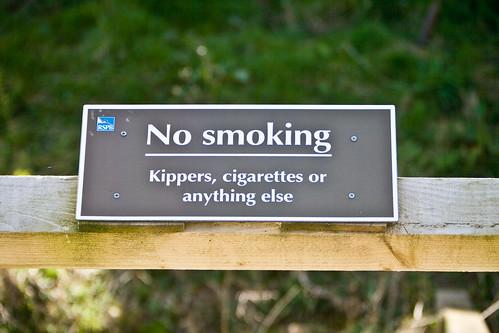
Image by Lepista [Flickr]
 The meeting was an eye opener and I'm so very happy that I went a long to it and can't wait for the next one in September (which I am contributing to, eek). There were various representatives from different companies there. Off the top of my head there was:
  • Natural England
  • INCA
  • RSPB
  • MMO
  • (Eastern?) IFCAs 
  • Environment Agency
  • PD Ports
It was really interesting to hear various projects being undertaken and the problems being faced or their progress. It has made me realise that there really isn't a simple one-size-fits-all solution (which I guess I knew anyway, but this has just verified it completely) and that the issues surrounding environmental management (of any ecosystem) are so multi-faceted that they require input from all of the major key players. All of them. Without this communication (and appropriate funding unfortunately), it's unlikely that there will be any success in the long-term.

This whole experience, meeting people from various companies, having a little input (well, talking about the project and hearing recommendations), having people genuinely interested in what's going on (and wanting information prior to the final report) has made me really happy that I've chosen this project. It has also made me realise that this is definitely the path I want to take, integrating it with the research side of things and liaising with contacts to attempt to come up with the perfect solution.

That concludes my day anyway, and now I need to go and completely rehash this CV and formulate some fantastic application for the perfect job in September (for me, anyway). I just hope that they see a little sparkle and go, "she's the girl for us".

Fingers crossed! 

Friday, 24 February 2012

Teesmouth & Cleveland Coast EMS: Bird disturbance surveys with Natural England.

I know it hasn't been long since my last update but I should really talk about my trip to Redcar before I get too busy (or maybe I am just using this as a useful procrastination tool... who knows?) Anyway, I have mentioned it before in a previous post but alas I shall repeat myself (hey, it beats reading a rather dry paper about IUU fishing... I need to find a better one) - As part of my MSc in Marine Environmental Management I have to undertake a 8-10 week project placement (not work experience per se, but a project) where I do research and subsequently write it up into a 5000 word report (essentially another dissertation). Well, I was in a little bit of a predicament with what I should go for and in the end I decided to go with Natural England (and INCA) and do a project assessing the impacts of recreational activities on the overwintering and migratory birds at the Teesmouth and Cleveland Coast European Marine Site (EMS). This would mainly be through the use of spatial analysis (ArcGIS) and statistical analysis (oh joy ~ I can use either SPSS or, if I feel confident in doing so, 'R'). Well, after contacting the current EMS project officer, Katherine (who is sadly leaving at the start of next month) we decided on a date to go over some of the methodology and meet with some of the team, mainly to introduce myself and get some direction for my actual placement.

So, Tuesday morning I got up bright and early, jumped in the shower and made myself look quite respectable (I opted for practicality, comfort and a little bit of style if that's what you'd call it). I wasn't at all sure of the weather (come on, it's England, we can have all seasons in an hour) so boots and leather jacket it was. I wolfed down some breakfast (thank you lifesaver of a boyfriend), grabbed my Kindle for some light reading on the train (Little Women) shoved this and that into my bag and proceeded to train station with about 10-15 minutes to go. Note: This was during rush hour in York, i.e. very very busy indeed, particularly coming through one of the main roads into York... Still, I made it with about 5 minutes to spare (another big thank you to boyfriend who played taxis that morning) and flopped on the train for an hour and 5.

I met with Katherine at Middlesbrough station and we made our way to Redcar Rocks or Redcar 'Scars' as it is commonly known. We took a walk down the beach and set up just before the development of flood defence structures and just before the actual rocks.

Redcar Scars - flood defence development to the right

Behind where we took the bird surveys from - vertical pier, coastal area regeneration.

The scope was set up, binoculars were at hand and survey sheets were out - Katherine showed me how the methodology was actually done for the two hour survey (in summer, just one hour in winter was sufficient). It was important to do a bird count (species present and abundances of each) before the survey started. Species we were looking for included: cormorant, curlew, dunlin, knot, oystercatcher, purple sandpiper, redshank, ringed plover, sanderling, turnstone and then we could mark down other species. During the actual surveying of bird disturbances, we had to record the number of humans in and around the area, what they were doing (i.e. dog walking, angling, diving, bait digging, horse riding etc) and whether their activities disturbed any of the birds and to what extent. It was quite interesting anyway.
 
Redcar Scars - beautiful beach.
In the middle of our survey Catherine and Martin joined us from Natural England and I briefly introduced myself and we had a bit of a chat about the project. We then had a quick drive to another site where we could see the Corus Steelworks. They were pretty magnificent I have to admit. I didn't manage to get a photo of the whole site (or maybe I did, I'll have a root through my phone) but the whole of the area was covered (and I mean covered) in grass from the sand dunes. It was remarkable that a whole ecosystem, a stable ecosystem had successfully established on the waste products of such industry.

Redcar Corus Steelworks and the South Gare (I think?) sand dunes, an ecosystem built on the slag (waste products) from the industry.
We had a bit of a walk down Coatham Sands, Bran Sands and South Gare (it was extremely windy but pretty tranquil and the weather was perfect) and I really was in awe with the scenery. Unfortunately we arrived at this site at mid-tide so it was neither high or low tide. We couldn't actually do a survey due to this, however we did spot several hundred oystercatcher roosting on an exposed area of rock.

Once we had finished having a look around this site, we quickly piled in the car and head towards one of the booked rooms where we could meet Mike (also from Natural England), do the formal introductions to him and the rest of the team and discuss which direction I could take my placement. I still need to have a proper think about this but I have plenty of time. I then sat through their meeting reviewing the methodology and assessing whether aspects of it needed changing (simplification, replicates, further investigations etc). We then discussed my project and what I need out of it regarding the MSc assignment (I said I didn't know, Rach just forgot to check the VLE didn't she? Silly thing!) and I sat through their discussion of Katherine's Code of Conduct (CoC) that she had formulated - it looked great! It was a voluntary CoC for all recreational users of the beach, highlighting the problems of their activity, recommendations for where they should do it (i.e. further up the beach, away from feeding birds etc) and other considerations. I thoroughly enjoyed reading it even if I did go a little quiet when it came to discussing improvements. Still, it was a great experience for me to sit through a typical EMS meeting like that.

I'm currently in the process of penning an e-mail to those I met on Tuesday thanking them for the day and giving them a little more information on what my project requires and although it states that this is not work experience I would definitely like to get some work experience alongside doing my project. I mean, hey, I might not get a chance like this again!

Thursday, 12 January 2012

Summer placement; The impacts of recreational activities on overwintering and migratory waterbirds at the Teesmouth and Cleveland Coast European Marine Site


Right, I've got myself into a little bit of a dilemma now. I originally ushered this idea away since I didn't think I'd a) enjoy it or b) be efficient enough in GIS or 'R' to do it. Upon speaking to Julie and a little bit of guidance from those close to me I've given it a bit of thought. If I did this well, as in, I did the study to the best of my ability, I had good references, I ensured that I did GIS correctly and efficiently, then this could really be the start of something....

Anyway, it involves working with the project officer - Katherine Simpson - and the lead [marine] advisor - Dr Catherine Scott of Natural England - doing a series of statistical analyses on the survey results undertaken in order to assess the impacts of anthropogenic recreational activity on this site. I'll be mapping the recreational activities and bird locations in ArcGIS and I would be developing a map of recreational activities occurring throughout the EMS (European Marine Site), identifying hot spots of bird locations and assess the impacts according to this. I reckon there would be some degree of research (to predict the impact) as well as to set certain areas where human activity should be restricted...

I'm stuck in the middle of the two really... I need to decide between fun and not particularly relevant, or desk-based (where? York? Redcar? I don't know!) yet skill-building... I think the latter will prove more useful in life right?