Friday, 13 July 2012

Middlesbrough - Meeting the EMS management team.

Wow, what a fantastic day yesterday was and, to be perfectly honest, I was completely bricking it. Me, meeting new people, talking about something I'm not all 100% sure on... It's normally a recipe for disaster but hey, maybe I'm changing... For the good.

I went to Middlesbrough to meet with the new EMS project officer, Maeve, to discuss the direction of my project placement with Natural England/ INCA/ RSPB and meet with the EMS management team for a meeting. Can you see why I was nervous?!

After a pretty hectic morning (early start/ delays at the train station and a not-so-brilliant coffee) I arrived in Middlesbrough, hopped in Maeve's car and after a quick introduction/ hellos we were on our way towards the INCA offices on the Wilton International site. As with all industrial sites (especially those that concern chemicals - eep), an induction had to be done which in involved watching a fabulous little video telling me about the various alarms that can go off. Now, which one means run and which one means take cover/ block all windows?! I guess I won't be too helpful in an emergency then...

After the induction and a quick photo I was presented with my day-pass (what a shame, I had to hand it back in at the end of the day), and my little card that says I've watched the video - hurrah! Now I mustn't lose it ;-) We had a drive round to the INCA offices where I met two of the team; Robert, one of the conservation officers who made me a lovely cup of tea (thank you!) and the director, Bob who I had heard a lot about. As there had been an issue with health and safety (long story and not really that interesting so I won't bore you with it). We went over the risk assessments, signed some documents and went over a few things to pass onto my York-based supervisor, and then left to return back to the computer to go over the project.

INCA - http://www.inca.uk.com/2012/05/how-can-inca-help-you/front-page-of-how-can-inca-help-you/


I'm really excited to get stuck in now, especially since I kind of know what I'm doing... Instead of producing two reports at the end (one for the university and one for the company), I'm producing one main report for the university and submitting it to the company also, and then just making up a series of recommendations in a separate non-scientific report for them - that works out better since I'd seen an example report and it was a good 100 pages long. I know a majority of those were from figures and tables (as mine would be in a way) but 100 was a little excessive. Anyway, from my terms of reference that I devised last week (and I'm actually pretty proud of it) we've agreed on some main objectives:-

ArcGIS
  1. Produce a map highlighting hotspots of bird usage (both abundance and behaviour - foraging or roosting).
  2. Produce a map highlighting recreational activities
  3. Map bird disturbance from each individual site (6 sites in total) with respect to the main anthropogenic recreational activities which will indicate problem areas.
 Statistical analyses (using R project)
  1. Which anthropogenic causes the most disturbance to birds
  2. Does anthropogenic disturbance appear to affect bird numbers/community composition and/or bird distribution at particular sites.
  3. Do disturbance levels differ with tide height, habitat type and day of the week (latter may not be included, it depends on the data set).
  4. At what times are recreational activities most apparent?
Essentially the main aim is to produce a series of site-specific recommendations with regards to the results - i.e. how are species effected, what are the grounds utilised for (with respect to both bird activity and human activity). I can also pinpoint which parts of the data collection need refining for statistical analysis - i.e. consistency - so that the methodology can be updated in the future.

Anyway, the EMS meeting was starting at 2pm and so we left around 1pm for the RSPB centre in Saltholme. I really liked it there despite the mass of industry around it. It was so very odd that the birdlife in this reserve can flourish with so much going on around it. Peculiar, but interesting.

The visitor centre, image from http://www.habitables.co.uk/architecture/saltholme-wildlife-reserve-rspb-jddk-architects

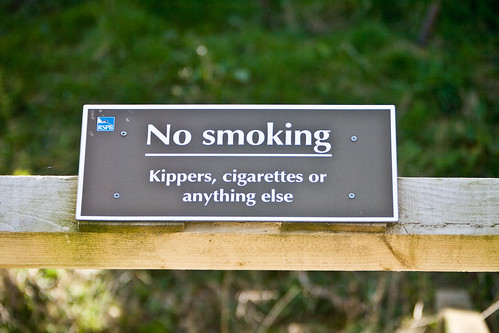
I had a little giggle as we walked up to the centre for whoever designed the signage had a sense of humour. It isn't my photo (I forgot to take one!) but it has definitely left an imprint on my mind (and hopefully other's too). I think this method of making a negative more positive is really effective at getting people to listen and pay attention.

Image by Lepista [Flickr]
 The meeting was an eye opener and I'm so very happy that I went a long to it and can't wait for the next one in September (which I am contributing to, eek). There were various representatives from different companies there. Off the top of my head there was:
  • Natural England
  • INCA
  • RSPB
  • MMO
  • (Eastern?) IFCAs 
  • Environment Agency
  • PD Ports
It was really interesting to hear various projects being undertaken and the problems being faced or their progress. It has made me realise that there really isn't a simple one-size-fits-all solution (which I guess I knew anyway, but this has just verified it completely) and that the issues surrounding environmental management (of any ecosystem) are so multi-faceted that they require input from all of the major key players. All of them. Without this communication (and appropriate funding unfortunately), it's unlikely that there will be any success in the long-term.

This whole experience, meeting people from various companies, having a little input (well, talking about the project and hearing recommendations), having people genuinely interested in what's going on (and wanting information prior to the final report) has made me really happy that I've chosen this project. It has also made me realise that this is definitely the path I want to take, integrating it with the research side of things and liaising with contacts to attempt to come up with the perfect solution.

That concludes my day anyway, and now I need to go and completely rehash this CV and formulate some fantastic application for the perfect job in September (for me, anyway). I just hope that they see a little sparkle and go, "she's the girl for us".

Fingers crossed! 

Wednesday, 27 June 2012

Post-dissertation relaxation, shark tagging & interviews!

I can only apologise for how dreadful I have been with updating but, alas, my thesis came first. Many hours of writing, a fair few tears, a few manic moments, a lot of procrastination (I'm a pro, don't you know?) and a few moody Rach's (okay, MANY...) and my thesis is done. Finito. FINISHED.

"Skating towards a sustainable future" - Fabulous title credit to my supervisor, Dr Bryce Beukers-Stewart,
I'm not entirely pleased with it, I don't think it was my best but given the circumstances I think I did pretty damn well and, at the end of the day, I can say I tried my hardest. I think I took a little bit of a wrong turn somewhere but it's all there, it's all handed in and there's nothing I can do about it now.

Regarding the presentations (that I was awfully nervous about) I did so well! It was worth 25% of my dissertation mark so, 10 credits. I got 73% ! I'm actually a little shocked. I stood up there and wanted to bolt, either through the door or out of that window, so how I managed to get that good of a mark I have no idea.

I also have a little more good news the other day. The exams that we sat those few weeks ago, those exams that I also thought I did dreadful in... well... I also did pretty damn well in: 72, 73 and 74%! That sets me in a really good place to obtain my distinction. All I can hope is that I can manage 70% in my thesis paper and the project placement which I am due to start soon.

So, where does it leave me? I'm currently in Scotland enjoying some well needed R&R but as soon as I get back I'm going to start on my project. I need to write a Terms of Reference up for Natural England (in the process of doing) and also a risk assessment that needs to be sent back to my university. That's nearly completed, I just need to give an overview of what my project entails but as I'll be doing that for the TOR I'll do them both at the same time. I haven't got anymore information on that just yet, although I did buy myself a brand spanking new laptop for my birthday so that I could work GIS on it.

One thing that I am very much looking forward to is a shark tagging trip in August. I was casually just browsing through Twitter and noticed that one of my followers was advertising a shark tagging trip from Liverpool and I couldn't help but jump at the chance. Matt's blog is here! For £45 we're going out for a day, catching mackerel for bait and catching Tope for tagging. I'm booked in for the 16th and I really can't wait.
Tope, image by Davy Holt


Tope, Galeorhinus galeus, is a slender shark that can grow up to about 190cm long and is widely distributed along the coasts of Britain and Ireland. Like most elasmobranchs they have a late age at maturity and low fecundity - this species tends to mature at around 12 years of age and produces about 20 pups ever 2-3 years, As such, they are protected under the Tope (Prohibition of Fishing Order) instigated in 2008. This Order prohibits the fishing of Tope other than by rode and line, and if Tope are taken on board the live-weight must not exceed 45kg per day. 

The tagging of these species helps to reveal information on spatial distributions - their long-term movements, migrations, site fidelity etc. I'm really excited to be apart of this and I think it would be a perfect opportunity to learn some new skills (and new friends of course). 

On top of this I've been asked to be interviewed and photographed for the Postgraduate "You@York" portal which will be showcased at the PG Admissions Forum. I'm quite excited for this (albeit a little nervous) a) I'd never done anything like this before and b) I think it would be great for boosting my confidence (... Plus I get to make myself look pretty for the photos!)


Everything seems to be looking up. The stress is off re: the dissertation but I know the heat is now on for that final push. I'm determined to do it, I'm determined to do well and I know, with a bit of effort (and hopefully less tears and more laughter), I can do it!


Thursday, 14 June 2012

Dissertation presentations, oh the stress.

Oh my goodness me, these past few weeks have been hectic and I've not really had much time to myself to write anything in this here blog. I've also started up another blog (completely irrelevant to marine biology but more my life, dreams, food (lots of it) and potential future projects) >> Love travel. Love food. Love life.

So I'm in the midst of my dissertation. I've actually just come back from the first day of presentations, I was presenting last and let me tell you that me and public speaking really don't work very well. I honestly felt like I was about to jump out of that window had my legs not turned to complete jelly. I need to get over this, but the nerves just kick in, my throat goes all dry, my heat rate goes about 1000 bpm and then I feel like I can't actually construct a sensible sentence. Oh well. It went okay I guess. I rambled for the first few slides and then felt that I really got into it (just about). I did learn a few things about my actual study though so that's reassuring.

I do also realise that I have to practically re-write and re-do my dissertation (as it stands at the moment anyway). It shouldn't take too long to rectify and I can add in some cracking information about the Bristol Channel. Anyway, I can't reveal all just yet... I'm going to make this an amazing paper, just you wait :)

Back on hiatus again... For now anyway. My dissertation is due in on the 25th (my birthday - la la) so I should try and do an update near then.

Au revoir! 

Sunday, 27 May 2012

Marine Protected Areas ~ Pleasing both conservational and fishing perspectives.

So here I am, yet again, blogging my revision notes in sheer desperation that something will stick in my mind. All I want to do is sit outside and soak up the sun’s rays with a beer (or Pimms) in hand, my friends, my man and some happy summer music. I’ve tried to sit outside and revise, of course I have, but there’s something so very tiring about having the sun on your head all day. Alas, I’ve moved inside… Again.

What have I got in store today then? I’m still on Protected Areas (my exam is tomorrow, oh I need a miracle) and whilst I know I could probably write an okay answer (as in, I’ll be able to muster up some information at least), none of the information that I’m trying to absorb is actually going in.

I’m fairly confident that a question will arise to do with the design of protected areas (or maybe the allocation) and what factors need to be considered in this process. There’s bound to be something although a question didn’t crop up on last year’s exam. I wonder. I made a note on the lecture material that I swore the lecturer had said there is bound to be a question on the design process so, if there isn’t, I’m probably screwed. Anyway…


(Image sourced from: http://blogs.nature.com/climatefeedback/2009/06/a_place_at_the_table_1.html)

Marine Protected Areas ~ Pleasing both conservational and fishing perspectives.

One of the biggest worries concerning conservation managers is probably how big a protected area needs to be. Of course, from a purely conservational approach you’d expect “as big as possible” which is essentially to backing perspective for Pew Environmental Group (and other such foundations). Based on the Species-Area relationship, a larger area of land (or sea) will encompass a larger proportion of species and thus would be the best provider of conservation for meeting those conservation targets set. Concurrent to this, a larger area of protection is likely to encompass great habitat heterogeneity which studies have established has a positive effect on species richness. All in all, it seems like the better option doesn’t it? Have a large protected area and you run a greater chance of meeting those targets.

Unfortunately, as I’m sure you are aware from my last blog post, bigger isn’t necessarily better. Yes larger areas can support more species and have greater habitat diversity, but what about those socio-economic factors that are likely to limit the maximum size extent of these areas. Stakeholder support is a huge element of designing and implementing protected areas that cannot be ignored, without their support (either through economic backing or compliance) the viability of protected areas is likely to fall through. Fishermen, for example, solely depend on fish stocks and the harvesting of such for their well-being. Establishing a marine reserve, a protected area that does not permit any fishing activity whatsoever, therefore displaces these fishermen into alternate areas or preventing them from reaping the benefits of decent fish aggregations. Unless you combine both conservation and fisheries management to create a protected area that makes both parties happy, you’re going to get very little support from these fishermen which can simply reduce the area’s effectiveness due to lack of compliance.

The benefits of marine reserves on adjacent fishing grounds has already been well established through various studies; an increase in biomass, abundance, density, size and species richness is expected with reserves. Halpern assessed the extent these in detail using a myriad of studies in 2003; there was an average increase in abundance by 63%, size by 80%, biomass (a greater indicator of species recovery) by 90% and species richness by 59%. This is excellent news for both conservational and fishery objectives. It is generally well-accepted trait that larger fish have a greater fecundity and produce more eggs and engage in more reproductive activities. A 10kg red snapper, for example, produces 20-fold more eggs than, say, 10 individuals weighing 1kg each. This pattern of increased fecundity has been exhibited in Mombasa Marine National Park, Kenya (paper by Rodwell et al. 2002) with a greater biomass of reproductive individuals within the reserve boundaries.

So, what does this mean for the fishermen? It means they can obtain much greater catches just outside of the boundary therefore everyone is happy. This is termed the spillover effect, whereby the benefits observed within the reserve ‘spill-over’ into adjacent waters, either by the movement of juveniles and adults to external waters or the export of pelagic eggs and larvae. In Mombasa fish traps close to the marine reserve boundaries exhibited a 3X greater increase in catch (despite the greater trap density). A similar story also occurred in St Lucia! The downside to this is it does take a while for the benefits to be seen, as with anything. Fishermen, like politicians, want their results there and then and I don’t blame them, at the end of the day their jobs are affected. It largely depends on the extent of damage that areas has endured, but good responses (i.e. doubled or tripled populations) can be expected within 3-5 years.

Going back to what was said earlier about size, the extent of the spillover effect is proportionate to the edge of the protected area. The probability of fish leaving the given reserve is all dependent on the amount of ‘edge’ the reserve has. So, whilst larger reserves are much better from a conservational perspective, from a fishing perspective they offer very little (since the chance of a fish leaving the area is much slimmer) and less likely to be supported. What constitutes as ‘too large’ depends on the mobility of the species within the reserve and also the local oceanographic conditions (i.e. current speed and habitat type will contribute to the extent of a species’ propagule dispersal abilities).

It’s a difficulty faced by those who design protected areas. The initial ‘protect or don’t protect’ is hindered by a multitude of other factors that may cross one of the areas proposed off of the list. Protecting areas that are already heavily impacted by humans, or areas that are consistently affected by natural disasters means that it is likely these effects are going to infiltrate the reserve boundaries. If so, then a much larger reserve is required otherwise species extinctions and extirpations are likely to occur. This then runs the risk of placing all your eggs into one basket – what happens when the whole reserve is affected by an external threat? What then?

Even after the protected area has been implemented, boundaries have been decided and stakeholders are on board, who is going to manage the area? Is it small enough to be managed by the local population – this has proven to be useful in various studies, but when the issues become too severe it requires regional or even global management, but is this to be from centralised governments or from non-governmental organisations? It is nigh impossible to choose a strategy that can fit every scenario because, in simple terms, one size does not fit all.

I think I’ve gone off on one there, but hopefully it is of some use to those who are interested and plus, it serves me well for my exams. I just now hope that a question relating to this comes up!


References for those papers cited:

Rodwell, L. D., Barbier, E. B., Roberts, C. M. and McClanahan, T. R. (2002) A bioeconomic analysis of tropical marine reserves-fishery linkages : Mombasa Marine National Park. Natural Resource Modeling, 15, 183-197.

Halpern, B. (2003) The impact of marine reserves: Do reserves work and does reserve size matter? Ecological Applications, 13, 117-137.

Monday, 21 May 2012

Protected Areas: Is bigger really better?

I'm in the midst of my revision for the exams lurking around the corner (quite literally, I have one on Thursday, one on Monday and then one on Wednesday. I am in no way prepared for the last one but I'm getting there with the others). I'm just about to start looking over my coursework for this module, "Protected Areas: Is bigger really better?" and thought, what better way to inject the information I had understood back into my brain than to educate those who might not really understand the predicament that managers face.

Why is protection needed?
Through a combination of habitat modification, non-indigenous species introductions and direct exploitation, humans have undoubtedly placed an excess amount of pressure on the Earth, and as such the protection of these affected areas is the foundation for all biological conservation strategies. A protected area (PA) is defined as being “an area of land and/or sea especially dedicated to the protection and maintenance of biological diversity, and of natural and associated cultural resources, and managed through legal or other effective means” (IUCN 1994). Protected areas (PAs) aim to alleviate the anthropogenic pressures mentioned above. As a result, it is imperative that areas are effectively conserved, protected and managed if we are to meet the demands of the Convention on Biological Diversity (CBD) which intends to significantly reduce the rate of biodiversity loss by 2020.

From http://www.marine-conservation.org/what-we-do/program-areas/mpas/

Representation
Although there has been an increase in the number of Marine Protected Areas (MPAs) globally, the ocean is still poorly represented when managing conservation priorities. Only about 1.17% of the world’s oceans are protected with approximately 6,800 designated MPAs. Land-based PAs however are expected to cover 13% of the Earth’s surface with over 120,000 designated PAs.

PA development
The development of PAs has, in recent years, taken a “no-take is best” and “bigger is better” stance, since the fundamental purpose of a PA is to preserve biodiversity. The Global Ocean Legacy programme of the Pew Environmental Group has largely driven the expansion of MPAs following their aims to establish a coherent protection network, something that has been highlighted as being highly important. Very large terrestrial PAs have typically aimed to conserve wilderness which unfortunately do not necessarily overlap with high priority areas. These areas biased towards lower quality lands and tend to have very little economic worth to humans.

Is bigger better? The SLOSS debate.
Based on the theory of island biogeography (MacArthur & Wilson 1967), an increase in size coincides with  an increase in species diversity and richness. These assumptions have been used to set baseline targets for conservation and are as such an integral part of the PA planning process. Early work suggested that larger PAs would be more beneficial to protecting biodiversity since they support larger species numbers, however since their establishment there has been an ongoing debate on the veracity of this. This is the 'SLOSS debate' (Single Large or Several Small). The outcome of the debate basically states that the "which is best" scenario largely depends on the objectives of the protected area, essentially no coherent conclusion was made!

An interesting point made was the potential for a population to recover after a catastrophe. Habitat fragmentation remains as one of the biggest threats to biological diversity since it increases the edge effect, a phenomenon whereby population densities tend to decline from the core to the peripheral habitat (or edge) due to the infiltration of human activity or natural threats which can hinder these populations. The smaller the population is, the more 'at risk' it is from extinction, however several small 'islands' of protection (depending on the extent of their connectivity) will have some level of interaction. These can act as reserve populations and help to repopulate an area. Very large protected areas (vLPAs) are expected to be so large that the risk of population extinction is very slim.

vLPAs and fisheries management
Whilst I am a (or aspiring to be at least) marine biologist maybe I should relate this whole thing to fisheries management and whether vLPAs are beneficial in this instance. As discussed by Roberts et al. (2001) it is highly unlikely that vLPAs would benefit fisheries as much as intermediate sizes. Lack of financial backing or stakeholder support would deem the implementation of these sites near impossible. Through the eyes of an eager fisherman, some marine reserves can be seen as pure gold mines since landings at these reserve edges can be exceptional due to something called "spillover". As the extent of spillover depends on boundary length and the edge-area ratio, vLPAs would not result in a high degree of spillover unless it was long in shape (rather than circular).

Target species
Protected areas need to be implemented with a species in mind. Small reserves have the capability to protect significant biodiversity in some species, such as in South African fynbos. Predators such as the African wild dog and brown bear, on the other hand, may require large areas to retain a decent proportion of their original species richness. vLPAs can encompass a species' entire range and as such as perceived as being 'better', however a tight network of highly connective reserves can achieve essentially the same thing. The (and I practised this a lot so I could actually say it correctly) Papahānaumokuākea Marine National Monument (Northwestern Hawaiian islands) is a prime example of this. For mobile species such as the giant trevally, the general consensus is that it is difficult to protect such populations due to their fluid spatial movements. By protecting important aggregation sites such as feeding or spawning sites, these populations can be protected without having to cordon off large areas.

What about cost?
In economic terms, a protected area may be seen as an investment - as such the expected benefits need to outweigh the potential costs before its implementation. A major cost involved is the displacement of fishermen from previously fished areas (should that area be closed to fishing activity). Asides from this aspect, protected areas are not cheap. Running costs of between $5 billion and $19 billion were estimated by Balmford et al. (2004) should we create enough PAs to meet biodiversity targets. Smaller reserves can be managed by small, local populations (community effort right?) whilst very large reserves suffer from the extreme demand for resources and personnel required to manage the large boundaries.


A brief summary of the advantages and disadvantages of vLPAs (in both terrestrial and marine sites) can be found below:


Advantages
Disadvantages
Support more species
Difficulties in enforcing protection over a large area.
Large protective core not affected by ‘edge-effects’
Conflict over land use and economical expenses.
Accommodate range shifts due to climate change
May not be as beneficial to fisheries as first thought.
Accommodate highly mobile/migratory species.


A few key references that I have cited here...
Balmford, A., Gravestock, P., Hockley, N., McClean, C. J., & Roberts, C. M. (2004). The worldwide costs of marine protected areas. Proceedings of the National Academy of Sciences of the United States of America, 101(26), 9694-9697

Roberts, C. M., Bohnsack, J. A., Gell, F., Hawkins, J. P., & Goodridge, R. (2001). Effects of marine reserves on adjacent fisheries. Science, 294(5548), 1920-1923.

I haven't referenced this one but it is really useful (for my revision and for those who are generally interested in marine reserves)

Roberts, C.M. & Hawkins, J.P. (2000) Fully protected marine reserves: A guide. World Wildlife Fund, Washington DC (link here: http://billhutten.s3.amazonaws.com/fw/docs/345.pdf)


Thursday, 10 May 2012

6th World Fisheries Congress, Edinburgh.


In typical Rachel-form I have this post and a few others in draft form that are in dire need of completing and publishing. Also in typical Rachel-form, I got far too exciting about the 6th World Fisheries Congress that I have just volunteered at and subsequently my post about the coral reef monitoring programme shall have to wait.

So, it all started when I received an e-mail from my supervisor at the University of York with a great opportunity. Reading the e-mail I became pretty damn fixated on the idea of me travelling up to Edinburgh for a few days and volunteering, both gaining some valuable experience and doing a fair bit of networking on the side. I immediately sent an e-mail to Angela from Congrex saying I was interesting, and felt a little disheartened when I didn't hear anything back. I assumed that the places were filled and they wouldn't require my services. Shame really, I would have loved to have done it.

A week or so later I received an e-mail saying that I had been chosen to be part of the volunteering team. Getting a little excited about the prospect of helping out at such a prestigious event (and obtaining a rather fetching blue t-shirt) I booked my train tickets, booked my accommodation for two nights and waited ever so patiently for the day to arrive. Now, for me to say I wasn't nervous about travelling up to Edinburgh on my own, meeting new people and rooting around for some confidence would be a complete lie. I was terrified! I do tend to have a pretty nervous disposition and as such rarely put myself out there and grasp life's opportunities by the horns. Why? Because I just stick my head in the sand. I knew that this opportunity was something I needed to go for. The 6th World Fisheries Congress is the olympic-event of the fisheries sector. It comes around once every 4 years and this was the first time it had entered UK waters.

So, Monday arrived and I was sat on the train. I'd forgotten my coffee which was a bit of a pain (hey, that rhymes). The journey itself was only 2 and a half hours long and I arrived in good time. I could have left at Waverely and walked to the hostel (20-30 minutes walk), but I decided to stay on and get off at Haymarket instead (1 minute walk to the hostel). Fabulous. Silly me didn't check the check-in time at the hostel so when I arrived at 11am-ish they couldn't check me in and I was left feeling a daft. I was able to leave my case in their laundry room which made things better and I proceeded to have a mooch around Haymarket before meeting the rest of the volunteer team at 1pm at the EICC.

The Edinburgh International Conference Centre, EICC. 
I had a twaddle inside and immediately felt nervous again. I signed in to the building, let them know I was a volunteer, picked up a t-shirt or two, grabbed my name tag that I had to wear at all times and went to get changed before joining the other volunteers for a briefing. I couldn't resist when it came to taking a cheeky photo of me in my gear. Excuse the toilet behind, it was the only mirror that I could get access to.

A little bit 'scene' but I couldn't care less - me and my fetching t-shirt and name tag (the wrong way round as it spent most of the time...)
T-shirt logo and the lovely shark keyring/bottle opener in the goody bags.

After the briefing we were given our training on the Congrex computers. My job was on the pre-registration desks alongside a few others. We were the first people that the delegates would meet upon entering the EICC and so it was important that we provided service with a smile (as per). The system was very easy to use, we had to lookup delegates based on confirmation number (that very few actually had) or surname (thankfully everyone has a surname so there was no problem here... Most of the time).

My lovely desk with a touch-screen monitor and a rather annoying keyboard.

Pre-registration on the Monday officially opened at 3pm, so shortly after the delegates came drifting in through the doors and guided to our desks. Easy peasy. They were checked-in on the system, name badges were printed, Duchy bags were handed out (with various goodies inside) and they were sent on their way, either to the New Registrations/Accounts desk (if there was an account query) or to the Tours and Social desk if they had a ticket to be exchanged.

Duchy Originals - Itchy, kind of smelly and moulted - A nice touch either way.

Drinks were being served at 7pm for the Welcome Reception downstairs in the Exhibition room and, as expected, 6.45pm proved the busiest time for the registration desks. Delegates were flooding in and it was an absolute mission trying to get through everyone. Thankfully we finished at 7.15pm and some of us made our way downstairs to meet and greet the delegates and have a really good mooch around the Exhibitions.

It was actually a really good opportunity to get some vital networking done. I walked around with one of the other volunteers who is significantly more confident then I am and basically followed like a little lost sheep most of the time. We spoke to Natural England for a long time which was nice (since I am working with them in July) and it has given me an idea to enquire about some graduate positions/ work experience within the North-West. After more networking, a glass of wine and a bottle of beer I was ready for bed (honestly, you try doing a long day on your feet talking to a lot of people and eating very little). By 9pm we were allowed to leave and I made my way back to the hostel for a good night's kip (... I wished).

I was up again at 5.45am (joy of joys) and after a pretty horrific night's sleep (being woken up by a lady on the lower bunk either a) snoring or b) sleep-talking rather loudly) I really did not want to drag myself out of bed but, alas, needs must. Also, today was a pretty big day since we needed to prepare for our 'special guest'.

Welcome to the 6th World Fisheries Congress
 The Opening Ceremony began at about 10am and was pretty impressive, I have to admit. We all piled into the biggest room in the EICC. I managed to wade my way through masses of people alongside two other volunteers so we could park ourselves on the second row from the front on the left hand side. Perfect spot. I thoroughly enjoyed Ray Hilborn's talk, mainly because he talked about the environmental effects of fisheries from a whole different stance. He basically suggested that the environmental costs of NOT fishing would cause a lot of stress for terrestrial habitats and cause a greater degree of biodiversity loss than if fishing took place. It was interesting since I hadn't really thought of it like that. The dilemma that we are in at the moment is that of food security. We have the challenge of sourcing food to feed nearly 7 billion people. If we take away one of the world's greatest suppliers of protein - fish - out of the equation then we need to find alternative sources, simple as. Based on a few of the statistics readily found on the web he made an interesting point regarding this, that in order to replace the world fish production by grazing at world average grazing productivity we would need 139km-squared of grazing lands.

Putting this into perspective, Hilborn provided an example of what this could do. The Peruvian anchoveta fishery has been extensively fished for years, yet to replace this fishery and supply the same amount of protein from land-based agriculture it would result in a vast amount of deforestation in order to allow for the extensive numbers of farmland that would follow. This, sadly, means that over 4500 orang-utans a year would suffer. Now, I'm not one for ignoring the 'little species' and focussing on the larger-than-life charismatic animals but he has got a point. Stopping the fishing industry completely would be incredibly detrimental to the longevity of terrestrial ecosystems and cause a serious decline in biodiversity.

Delivering his speech. Image by MarineLink (http://www.marinelink.com/news/fisheries-edinburgh344482.aspx)
Those present in the opening ceremony were also privy to a talk by none other than HRH Prince of Wales. Prince Charles gave a rather passionate speech (I thought so anyway). His keynote speech can be found here.

In between the mingling, actually doing the job at hand and serving the needs of anyone who required assistance, I managed to see a few of the talks. One of which was about the CFP Reform, the panel being Richard Benyon, Lowri Evans, Richard Lochhead, Tony Long and Julio Morón. The session I saw was set out much like the BBCs Question Time where a panel answered a series of questions asked by the audience. I only popped in for the last half an hour but it was interesting to say the least. I managed to hear about their views on discards and the discard-ban, and also about subsidies. Now I was trying to tweet furiously (as were several other of the delegates as I realised). Whilst most of what I was saying probably sounded like complete and utter rubbish (I just don't know enough about it).
"Stopping discards are good but need to maintain biomass in oceans and thus focus on what is being landed rather than protein landed"
I met some wonderful people during my two days there. I was honestly gutted that I didn't feel well enough for my final (3rd) day but I learnt a lot and feel like I have come away from a fantastic experience. I just hope the 7th World Fisheries Congress is within the EU and that I can hopefully volunteer in the next four years... We shall see.


Thursday, 26 April 2012

Diving in the Red Sea: A week of fun before the work really started.

Oh my goodness, life is practically running away with me at the moment and subsequently I haven't had time to blog. Anyway, what a busy month I've had. I went to Egypt for three weeks, I came back and literally did nothing for a week (except sit back and enjoy said life, oh and worry about the next few weeks) and then last week I started the assignment that was set as part of the Egypt trip and last night frantically revised for the exam (also related to the Red Sea) this morning. I'm actually supposed to be tidying my pigsty of a room that my loving boyfriend kindly tidied whilst I was away. Needless to say the tidiness didn't actually last long and as soon as I returned it looked like a bomb had hit. It was my way of saying, “I'm baaaack”.

So where do I start?

Egypt was simply fantastic. I've been to the country before but only as part of a day trip on a cruise (docked at Port Said and visited Cairo – typical touristy thing to do but it was wonderful). This time we were off to Sharm-El-Sheikh to a) have a semi-relaxing week of diving with Ocean College and b) engage in an intensive two-week coral reef monitoring course led by Dr. Rupert Ormond and his wife Dr. Mauvis Gore, and also two of our own lecturers Prof. Callum Roberts and his wife Dr. Julie Hawkins. I think I'm going to do a separate post about the actual monitoring course because it is, to some degree, educational and I believe it'll be of interest to some of you at least. So, for the time being, here's a little insight into my first week in Egypt... 

Come fly with me, lets fly lets fly away.
I'm not going to bore you with the details of the flight,  nothing really happened except that I was sick (before I even got to Egypt? Wow!) My friends and I had a good flick through the Lonely Planet's guide to Egypt and taught ourselves some Arabic which was actually restricted to hello = Salām 'alaykum and thank you = Shukrān (the latter of which was used extensively during the trip). We arrived in Sharm-El-Sheikh, paid for our Visas (which were needed to leave Sharm, i.e. whenever we were going to Ras Mohammed National Park) and arrived at Ocean Club hotel round 10 pm. It was quite a nice place, very basic but we weren't exactly paying much and breakfast was included. 

Home sweet home for the next three weeks.
18th March 2012
After a really good night's sleep and some breakfast in the morning (bread, bread and ... bread?), we grabbed our bags, our snorkels, our masks, our fins and went to find the beach for a snorkel session. We vaguely knew the direction so we carried on walking, and walking, and walking until we found it. I'm not 100% sure of the name of the beach but a friend has just informed me it is in Ras Um Sidd (if anybody does know the name or recognises it from the photos please tell me).

Beautiful blue water with an incredible fringing reef.


Just before the sun began to set.
We decided not to bring the wetsuits with us since we didn't think the water would be that cold. I think we were in for about an hour in just bikinis and rash vests and it was freezing. Very beautiful site though and definitely one of the most beautiful reefs I've snorkelled over. We saw plenty of things for sure, at this point I didn't really know many of the names but I scribbled down what I could remember: Picassofish (Rhinecanthus assasi), blue-spotted stingray (Neotrygon kuhlii), either a Red Sea needlefish or houndfish (Belonidae), Blotcheye soldierfish (Myripristis murdjan), Lyretail anthias (Pseudanthias squammipinis), various butterflyfish (Chaetodontidae), damselfish (Pomacentridae), anemonefish (Amphiprioninae), wrasse (Labridae), parrotfish (Scaridae), surgeonfish (Acanthuridae)... Can you guess that I gave up trying to find individual species?

During the snorkel session. Maybe I should buy a different coloured rash-vest so I don't look quite so naked. Photo by Gemma Galbraith
We walked back, quickly showered and head out to Old Sharm market to find a fish restaurant 'Fares' that the hotel manager had recommended to us. It was an absolutely delicious meal with about 2kg of fish, unlimited bread, water, dip, roasted vegetables, rice, everything you could imagine for about 100 EGP each (£10 give or take). I couldn't help but notice the incredible number of cats in Sharm, also, something that I enjoyed (me being a cat lover and that). 

19th March 2012
The next day we were being picked up at 7.50am to go to the Ocean College centre at the Hilton Fayrouz. It was time to complete my PADI Open Water diving qualification with Catherine at last. We filled out the necessary paperwork and introduced to Clare who would be our instructor and our guide for the week (and helper for the monitoring course funnily enough) and proceeded to get kitted up, BCD and regulator time. To finish the dives we headed to a local site, Ras Katy, after we all boarded on our ride for the day - Gamila (beautiful in Arabic). Dive number one was extremely successful, although it was rather weird diving in the sea. I was originally kitted up with 10kg of weight, but needed to drop 2kg since I was too heavy at depth. I had a few issues with my ears (standard), I just couldn't equalise. I went up a few metres, did some jaw-wiggling and such and it finally sorted itself out. Clare suggested I should try swallowing just in case that would help, figures that I can equalise by swallowing and swallowing alone (I wish it worked all of the time though). Managed to make a big rookie error and signal out of air instead of 'something isn't right'! She knew what I was on about so that was good... 

We had a bit of a swim around after we completed the mandatory skills and saw plenty of lovely fish including the anthias, anemonefish and plenty of red-toothed triggerfish. Got back onto the boat, quickly completed the skill review (100% thankfully), had some lunch and had a bit of a sunbathe before the next dive. The second was at Katy St Temple and had a really good swim around. It was much better after ditching the 2kg. Noticed that whenever I was trying to deflate my BCD I was actually rolling over to my side as if I was cuff dumping (the procedure used for deflating when in a dry suit)... I quickly got out of that habit though. We managed to meet up with the others who were having a dive around. Catherine signalled that she was out of air and so went up to the surface. I stayed down with Clare and Tim for the remainder of the session since, for some reason I have pretty good air consumption. I put it down to having little lungs (and starting the dive on a decent amount of air). Over these two dives we saw some moray eels, blue spotted ray, sea urchins (plentiful), two lion fish (how cute!), masked pufferfish, Napoleon wrasse, peacock grouper (beautiful things) and another moray, this time a yellow edged one. It was a brilliant day and both myself and my friend Catherine came away as newly-qualified PADI Open Water divers - hoorah! I was that knackered, however, that when I get back to the room I proceeded to curl up in a hoodie and sleep.

Moray eel. Photo wasn't taken at this site, but it's such a brilliant photo I couldn't help but put it on. Photo taken by Gemma Galbraith

20th March 2012
Day two of diving was actually day one of our pre-booked dive package (4 days diving for £99). This day were on-board Sonya and were heading towards another local site - Fiddler's Garden. Whilst there were other divers on the boat alongside us 'uni lot', we stuck together as a group and Clare led us as our dive guide. The first dive was down a mooring line which was nice, it is a lot easier to manage your depth this way since you have some kind of guide.

Making our way down the mooring line, there's me at the bottom with the bright yellow fins! Photo by Tim Cross.
 
 My mask flooded a lot on the first dive which I wasn't happy about. I had no problems with clearing it however (thankfully that it one of the more useful skills we learn), but it was just an annoyance and as I'm only a beginner I was worried about my buoyancy at the same time. It ended up being that my mask was on a little too high (a common problem if the mask it too tight, it'll begin to slip). I slackened it off for the next dive and I had no problems at all. The second dive was much more enjoyable (due to a behaving mask!) and I managed to stay down for quite a while - 57 minutes for the first dive, and 60 for the second. It was crazy though, both dives I went in on 240 bar and came out with 70 bar. At both sites we saw plenty of fish and it never ceased to amaze me how wonderfully beautiful the corals were (bearing in mind I've never really seen any of this before, I can't imagine it ever getting boring though). We saw plenty of female lyretail anthias (below), octopus, anemonefish (yes, I did used to clap whenever I saw them - little overexcited me), butterflyfish, more moray eels, lion fish etc.

Anthias in the plenty. Photo by Laura Irvine.

Anemonefish in their home. Photo by Gemma Galbraith.


21st March 2012

  Day three of diving was on-board Sonya again, but this time we were heading to Ras Mohammed National Park. I was so excited about diving here, I didn't actually think I'd get to do it because I know it is a little more difficult due to currents and we have to take on board drift-dive procedures (actually very simple and fun if there's a good current behind you). The conditions were really good on the first dive although I couldn't notice much of a current (which I guess is good, knowing me I would've ended up drifting away to some faraway place). 
I was balancing, not posing... Honest! Photo by Tim Cross
A tuna was spotted on this dive, but unfortunately I didn't see it. There were a fair few bluefin trevally (Caranx melampygus) though which are lovely fish, they belong to the jack family (Carangidae). The best sighting on this dive, however, had to be the sea turtle we saw just lazying around. Thankfully everyone managed to have a quick look at the beautiful creature before he swam off to the surface. 

Hello buddy! Photo by Gemma Galbraith

Swimming away. Photo by Tim Cross.
The second dive was equally as wonderful, this time we were at Shark Reef and Yolanda Reef. This is one of Egypt's most prized diving locations and I can see why. It is definitely ticked off as my favourite site. These reefs are two mountain-like spots with a sandy bay in the middle that you need to hug in order to not get caught in with the current. We dropped in by Anemone City which was nice and gentle (hey, I'm a beginner) and then made our way first passed Shark Reef and then to Yolanda Reef which is a site made up of the remains of a shipwreck which was carrying bathroom fittings as cargo. As you can imagine, coming across a reef of bathtubs, toilets and sinks is quite remarkable. We saw another turtle on this dive which was amazing, and I managed to spot my first ever Nudibranch. I was so excited to see the little fella, they're so cute. This one was a Pyjama Chromodorid (below).

Pyjama chromodorid (Chromodoris quadricolor). Photo by Gemma Galbraith.

Crocodile fish, also spotted on the dive. Photo by Tim Cross.
 
Just before we were ready to do our 3 minute safety stop at 5m, we spotted an absolutely massive Titan triggerfish (Balistoides viridescens). I didn't realise they were so territorial however, and they actively defend a cone-shaped territory, so whilst you think you might be out of their range... You aren't. Thankfully, none of us actually got in its way but I've heard they can deliver quite a nasty bite. By the time we were doing our safety stop, I was getting quite low on air. This was fine, I knew I was close to the surface, but unfortunately it did make me pretty buoyant (remembering that I had to drop the 2kg weight as I was too heavy). I had a little bit of trouble keeping at the 5m depth but I managed it in the end. I did find it pretty tiring getting back to the boat, I ended up on 50 bar and I could feel it pulling a little, plus it was hard work getting onto the back of the boat at the end.

22nd March 2012
It was day four and I was, admittedly, getting a little tired. We were on-board Noble Sheikh and were originally heading for Tiran but unfortunately the rough conditions did not permit this. We did one dives within the straits instead (at Ras Bob) and then managed to get to Tiran for  the second dive at Gordon's Reef (thanks Clare for clearing that one up with me!)

Just hanging around. Photo by Tim Cross.

 The first dive was beautiful, as the others, and we managed to see two swimming lionfish - such beautiful fish. One of them was a clearfin (with white spines). There was a lovely patch of sand that we had to hug and we came across a little patch of Red Sea garden eels, they are adorable. Unfortunately, being the excited being I am I got a bit too close to them and clapped (yes, yes I get it, I need to stop doing it) and a few of them shot back in their little holes. I'll learn... One day. I managed to stay down for 60 minutes and return with 90 bar (see, told you, little lungs). Upon returning to the boat myself and Gemma had a fun time rolling around on deck attempting to peel off wetsuits and change tanks for the next dive. I think we provided A-class entertainment for the guys on board.

The wreck at Gordon's Reef
The second dive was in a lovely location. We actually stopped here for lunch and tried to take a few photos of the wreck but unfortunately my camera just isn't good enough. I tried however (above) and I think it came out okay. This was another beautiful dive but I spent half of it diving around half-blind as my mask kept fogging up. It is such a common problem with a new mask but I thought I had de-fogged it quite well (toothpaste trick to remove the film). The dive itself didn't particularly start well either. The swell from the boat meant it was rather difficult to 'step in' and I ended up practically lunging forward and being semi-pushed in. I wasn't a happy bunny! It was another long dive, though, and once I had got into the routine of fogging - flooding - emptying my mask it was all a-ok. 

23rd March 2012
Everyone bar myself, Catherine and Bex had completed their 4-day dive package and so it was just us left. We were back on Noble Sheikh and it was the last day of diving. We returned back to Shark and Yolanda Reef for a lovely dive, it really is practically untouched (relatively speaking) and the amount of colour on the reef is spectacular. Conditions were quite bad again for this dive, and yet again, I ended up flailing around and got pushed in when I wasn't quite ready. I didn't even have time to cover my mask or regs. As soon as we got in we had to go down to 5m (otherwise we would be pushed against the rocks and coral) and that's where the problems began for me. Now, not wanting to scare anybody off diving I need to say that this was most likely due to my own error and panic. I'm a nervous person, naturally, so when something isn't right or I'm rushed to do things I do tend to panic a little bit. Anyway, I went down to 5m and everything was fine. Descended a little bit more and just could not equalise. Finned my way up a few metres and everything was fine, and then somehow I dropped and just kept dropped to about 23m. Going at that speed and not being able to equalise at the same time meant I was left with very sore ears. It was a completely unintentional drop and I made my way back up to 16 or 17m but my ears were still sore (although not squeezing any more from the pressure). Despite the panic I still managed to finish my dive on 110 bar (bottom time: 56 minutes). It was a nice multi-level dive, however, so that's probably the main reason for it.

Our surface interval for that dive was quite long, say about 3 hours, and I just did not feel well at all. I tried to have a bit of a sleep to a) get some energy back and b) hopefully drain my ears since I was half-deaf. My right ear was in a bit of pain and I just did not want to take the chance of diving again and damaging it. The dive instructors (and those much more experienced than me) said I definitely made the right decision and that I was being wise... I mean, I wanted to dive on the coral reef course (the week after) and I didn't want to hinder my chances of doing so by blowing my ear drum out. 

The end of a fantastic week
Despite missing my boyfriend a lot, missing food (I was on an epic mission to avoid all fruit and vegetables... in the end we tried them and we were all fine so that was good) and missing some home comforts, I had an absolutely fantastic week diving in Sharm-El-Sheikh. It was nice to get our bearings in a new place, be broken into the heat (it got gradually hotter as the week went on) and see some amazing sights before we started the coral reef monitoring course. Returning to Sharm and diving with Ocean College is definitely on the to-do list in the future, and it would be interesting to see whether the reefs do degrade any more over the next few years or whether divers, snorkellers and beach-goers alike can learn to look and admire but most definitely not touch. An unlikely event but, we shall see. 

Recommended links